Storage
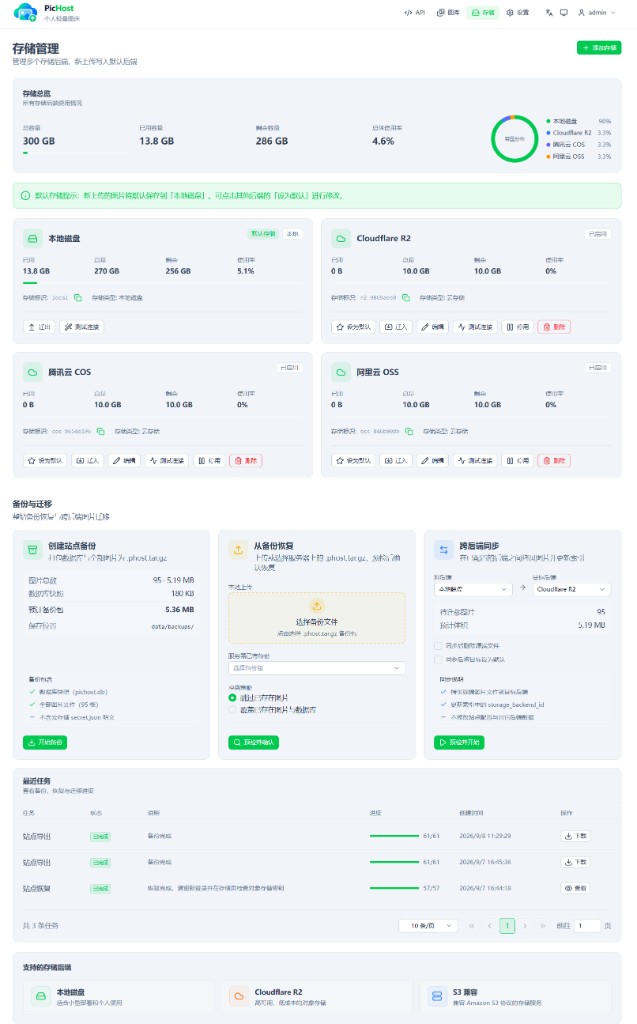
PicHost supports local disk and S3-compatible object storage (Cloudflare R2, Tencent COS, Alibaba OSS, AWS S3, etc.). Admins manage backends at Storage (/storage); new uploads go to the default backend. The page shows a storage overview (total, used, remaining, usage rate, capacity chart) plus per-backend cards and supported backend types.
Layout (local)
/data
├── pichost.db          # SQLite: users, sessions, settings, storage_backends, images index
└── images/ # All files when using local backend- New uploads:
images/randomId.webporimages/YYYY/MM/randomId.webp(flat mode in Settings) - Migrated legacy:
images/blog/...and similar - With cloud backends, blobs live in the bucket; index stays in SQLite
images
All keys start with images/. The upload API does not accept a folder parameter.
Classification uses per-user tags in SQLite (tags / image_tags); disk paths are unchanged. See API.
Adding a backend
- Sign in as admin → Storage → Add backend.
- Choose local disk or S3-compatible (R2 / COS / OSS presets).
- Enter connection details (bucket, endpoint, keys).
- Set as default so new uploads use it.
New object-storage backends get an auto-generated storage ID prefix: local for disk; r2-* for R2; cos-* for COS; oss-* for OSS; s3-* for AWS S3 and custom S3-compatible endpoints (immutable after creation; the image index references this ID).
Cloudflare R2
| Field | Value |
|---|---|
| Endpoint | https://<account_id>.r2.cloudflarestorage.com |
| Region | auto |
| Bucket | Your R2 bucket name |
| Keys | R2 API token access / secret |
The cloudflare branch streamlines R2-only deploys; see branch notes on the docs overview.
Environment variables (optional)
Some installs seed a default S3 backend via STORAGE_BACKEND=s3, S3_ENDPOINT, S3_BUCKET, S3_ACCESS_KEY, S3_SECRET_KEY, S3_REGION. UI-configured backends live in SQLite alongside env-based defaults.
URL modes
| Mode | Behavior |
|---|---|
| proxy | Serve via PicHost (GET /images/...) |
| public | 302 redirect to bucket/CDN public URL |
Copied links use IMAGE_BASE_URL. “Hide folder prefix” may shorten URLs; the server resolves by path or basename.
Usage & gallery filter
- Per-backend usage on the Storage page
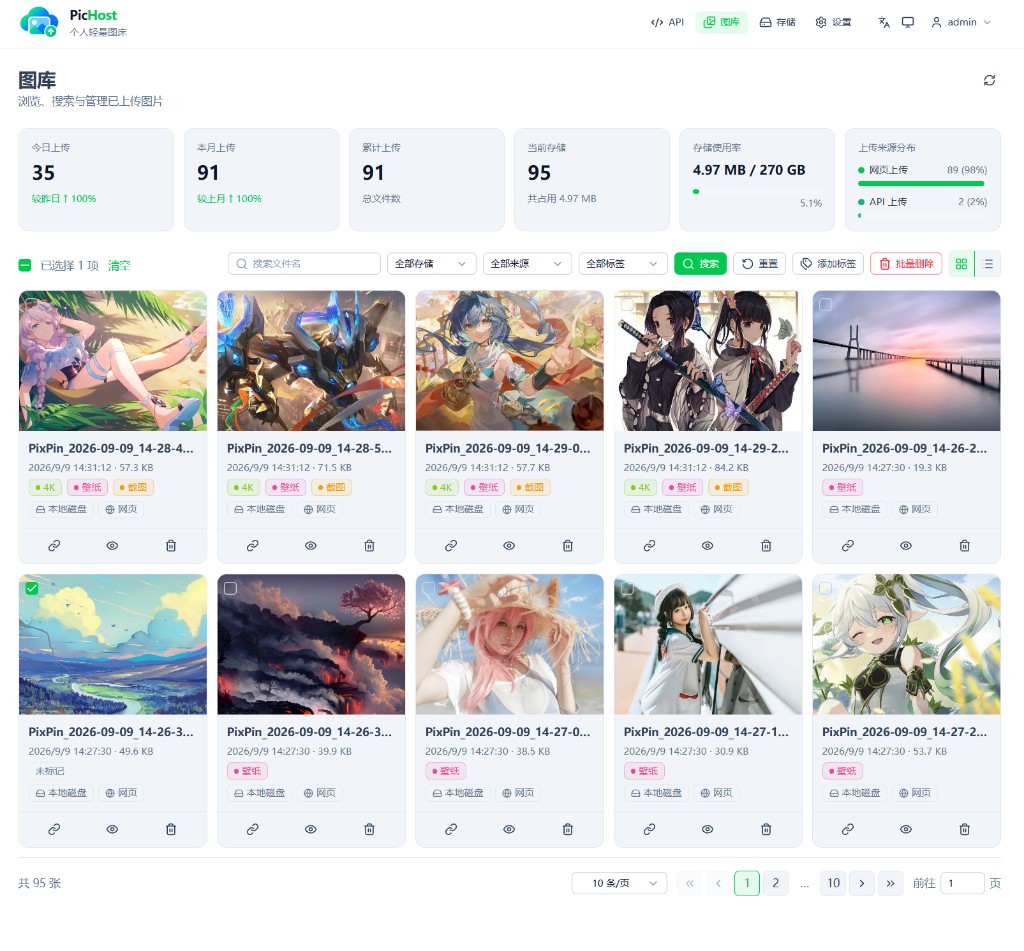
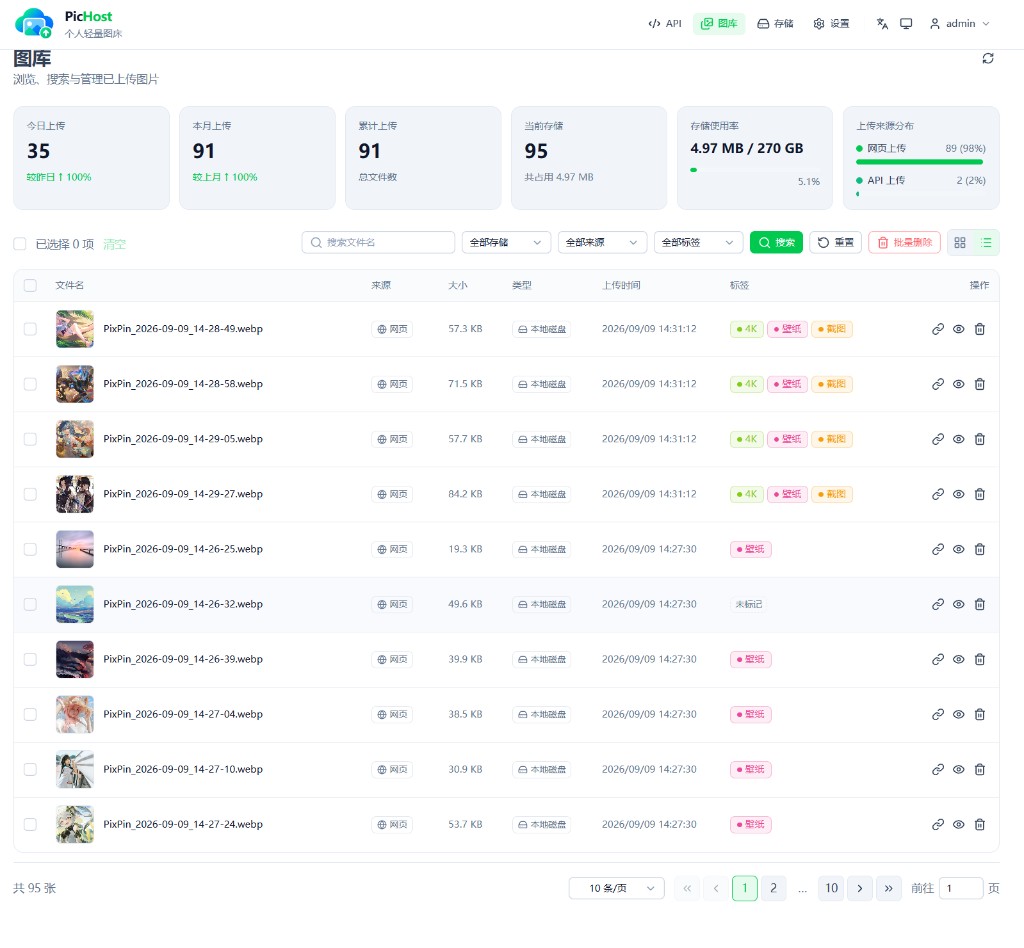
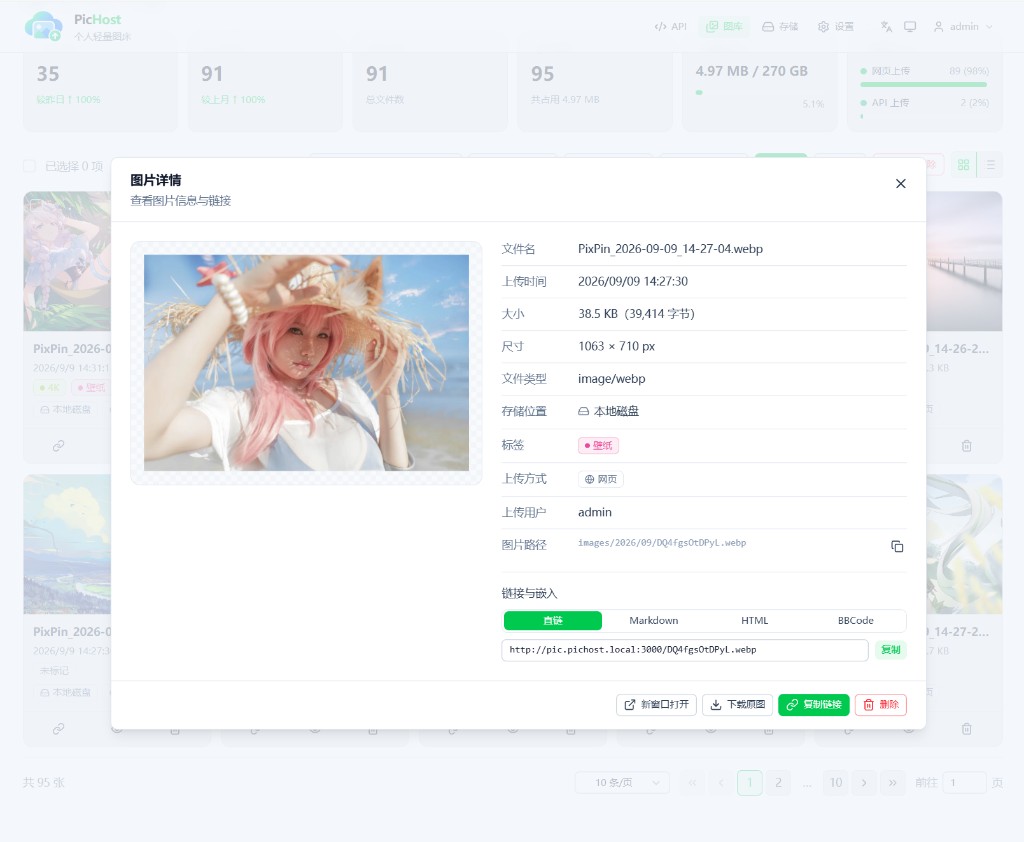
- Gallery filters by storage backend, upload source, and tags; grid/list view toggle; click a thumbnail for the detail modal (dimensions, storage path, tags, link formats)
Backup & migration (v1.3.0+)
The Backup & migration panel has three action cards and a paginated Recent jobs table below:
| Feature | Description |
|---|---|
| Create site backup | Export .phost.tar.gz with pichost.db and all images (including objects on cloud backends); shows estimated size and package contents |
| Restore from backup | Upload locally or pick an existing package under data/backups/, preview, then confirm; skip or overwrite conflicting images |
| Cross-backend sync | Copy images between configured backends and update the index; shows pending count/size, dry-run, optional delete-source and set-default |
- Exports are saved under
data/backups/; only one backup/migration job may run at a time - Job list supports pagination; download exports, view restore summaries, retry failed sync jobs
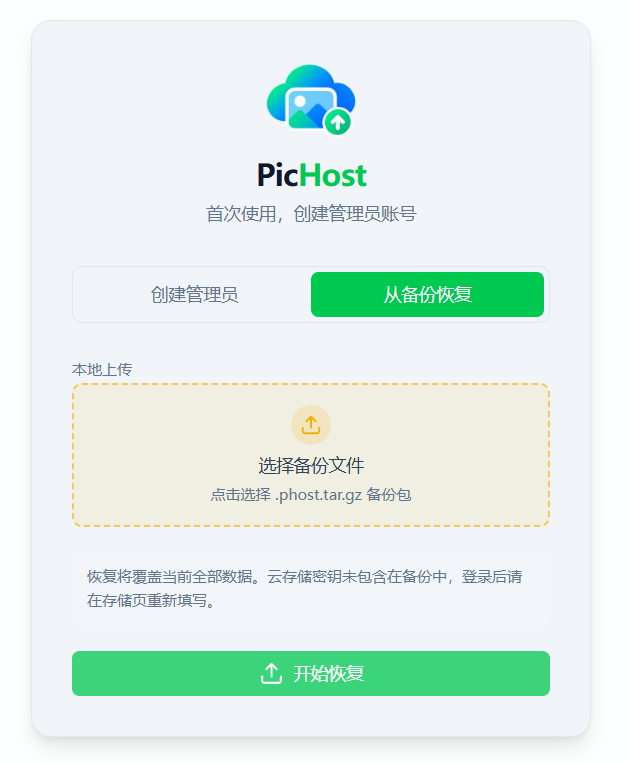
- Packages do not include cloud storage secrets — re-enter them on the Storage page after restore
- Uninitialized instances can use the Restore backup tab on
/setup(always overwrite mode)
CLI
docker exec pichost backup-export
docker exec pichost backup-restore /data/backups/pichost-xxx.phost.tar.gz
docker exec pichost backup-restore /data/backups/pichost-xxx.phost.tar.gz --overwrite
docker exec pichost storage-sync --from local --to s3-xxx --dry-run
docker exec pichost storage-sync --from local --to s3-xxx --set-default
Local development (project root):
npm run backup-export
npm run backup-restore -- data/backups/pichost-xxx.phost.tar.gz
npm run storage-sync -- --from local --to s3-xxx --dry-run
Manual backup
You can still back up data/images/, data/pichost.db, and bucket objects directly; prefer the full-site export above.